This is part three of a series of posts that will examine the Republican delegate allocation rules by state. The main goal of this exercise is to assess the rules for 2016 -- especially relative to 2012 -- in order to gauge the potential impact the changes to the rules along the winner-take-all/proportionality spectrum may have on the race for the Republican nomination. For this cycle the RNC recalibrated its rules, cutting the proportionality window in half (March 1-14), but tightening its definition of proportionality as well. While those alterations will trigger subtle changes in reaction at the state level, other rules changes -- particularly the new binding requirement placed on state parties -- will be more noticeable.
SOUTH CAROLINA
Election type: primary
Date: February 20
Number of delegates: 50 [26 at-large, 21 congressional district, 3 automatic]
Allocation method: winner-take-most/winner-take-all by congressional district
Threshold to qualify for delegates: n/a
2012: winner-take-most/winner-take-all by congressional district
--
South Carolina is unique among its carve-out state brethren. Sure, the presidential primary in the Palmetto state is First in the South, but the South Carolina primary represents the lone exception to the proportional delegate allocation that the other three states -- Iowa, New Hampshire and Nevada -- use. Actually, that distinction means South Carolina is the only non-proportional state (at least by the Republican National Committee's standards) before March 15 opens the post-proportionlity period of the 2016 presidential primary calendar.
The other three carve-out states utilize an allocation system that proportionally allocates their respective shares of delegates based on the statewide result of the primary/caucus. South Carolina, on the other hand, is a state where the distinction between at-large and congressional district delegates matters. The key here is that in Iowa, New Hampshire and Nevada, the statewide vote affects a pool of delegates that includes at-large, congressional district and sometimes automatic delegates. In South Carolina the pool is separated. The statewide vote dictates who wins the 29 at-large and automatic delegates, and the results in the state's seven congressional districts directs the allocation of each district's respective three delegates.
If a candidate wins the statewide vote, that candidate claims all 29 delegates. If a candidate receives a plurality in one of the seven congressional districts, that candidate is awarded all three delegates from that district.
A statewide win means that the resulting allocation of delegates is weighted in favor of the winner. Said candidate would not only claim over half of the available delegates (29 out of 50), but would also be well-positioned on the congressional district level as well. Winning statewide tends to but does not necessarily mean doing well in the congressional district vote. While Newt Gingrich won South Carolina in 2012, he lost one congressional district and its two delegates to Mitt Romney. Similarly, John McCain won South Carolina in 2008, but split the then six congressional district with Mike Huckabee, yielding the former Arkansas governor 6 delegates.
In both cases, the winner left the South Carolina primary with at least a three to one delegate advantage over the next closest competitor. And in Gingrich's case, it was more than 10:1.
The South Carolina Republican allocation method, then, is built to advantage the winner more than a strictly proportional method of allocation, but less than a strictly winner-take-all scheme. It should be noted however, if a candidate wins statewide and in each of the seven congressional districts, then South Carolina essentially becomes a winner-take-all state.
--
One additional area where there is some observed variation between states concerns how and how long delegates are bound to particular candidates at the national convention. The South Carolina Republican version of this has the delegates voting for the statewide winner or the winner of the congressional district on the first ballot only. If that candidate/those candidates is/are not nominated then those delegates are bound to the second or third place finisher statewide or at the congressional district level. If none of those three are nominated, then the delegates are unbound.
Presumably, the system works the same way for candidates who may have won South Carolina delegates, but who subsequently withdraw from the race. Those candidates are less likely -- obviously -- to have their name placed in nomination at the convention in Cleveland. But should a winning candidate withdraw, then their delegates are then bound to the second place finisher. If that candidate drops out, then the delegates go to the third top vote-getter. In both cases, that delegate transference is dependent upon the candidate ultimately being nominated. If not, then those delegates will be unbound free agents.
--
State allocation rules are archived here.
ADSENSE HERE
Showing posts with label carve-out states. Show all posts
Showing posts with label carve-out states. Show all posts

2016 Republican Delegate Allocation: NEW HAMPSHIRE
UPDATED 2/9/16
This is part two of a series of posts that will examine the Republican delegate allocation rules by state. The main goal of this exercise is to assess the rules for 2016 -- especially relative to 2012 -- in order to gauge the potential impact the changes to the rules along the winner-take-all/proportionality spectrum may have on the race for the Republican nomination. For this cycle the RNC recalibrated its rules, cutting the proportionality window in half (March 1-14), but tightening its definition of proportionality as well. While those alterations will trigger subtle changes in reaction at the state level, other rules changes -- particularly the new binding requirement placed on state parties -- will be more noticeable.
NEW HAMPSHIRE
Election type: primary
Date: presumably February 9 [not officially set yet]
Number of delegates: 23 [14 at-large, 6 congressional district, 3 automatic]
Allocation method: proportional based on statewide results
Threshold to qualify for delegates: 10%
2012: proportional primary
--
The more things change, the more they stay the same.
While the presidential primary calendar and the position of New Hampshire primary specifically have changed over the years, the Granite state has always maintained its position as the first presidential primary in the queue and has had the same method of allocating national convention delegates for the majority of the post-reform era. That is to say, New Hampshire has been first and has allocated a share of its apportioned delegates to candidates based on their statewide performance in the presidential primary.
There is a 10% threshold set by state law that candidates must reach or surpass in order to qualify for delegates, but New Hampshire, with so few delegates traditionally, is customarily less about the delegate score than it is about winning, placing or showing (as compared to expectations). Winning some small fraction of just 23 delegates means less, in other words, than punching one of the limited number of tickets out of the Granite state. It is the result that tends to winnow the field rather than the delegate haul.
Still, since FHQ is here to discuss delegate allocation, let's do so fully. The one caveat to all of this is that fractional delegates round to the nearest whole number. Any leftovers -- unallocated delegates -- are awarded to the top vote-getter. 2012 offers a nice example of this practice. Mitt Romney won just under 40% of the vote. That cleared the 10% threshold and meant he was awarded a 39.3% share of the 12 delegates that were available in New Hampshire (post-penalty). The former Massachusetts governor and eventual nominee received 5 delegates, Ron Paul netted 3 and Jon Huntsman got 2.1 The two remaining unallocated delegates -- again, out of 12 -- were allocated to Romney, the winner of the statewide vote. Romney, then, received less than half of the statewide vote, but got more than half of the available Granite state delegates.
There is, then, a little boost that is provided to the winner in the event that there are unallocated delegates. That advantage may be enhanced even more depending on which candidates in a large field clear the 10% threshold. If many candidates qualify for delegates, the winner's cushion will be minimal, but if just a handful of candidates meet the vote share requirement, the number of unallocated delegates to be awarded to the winner will increase.
If we were to use the Huffington Post Pollster average (as of 2/9/15) in the New Hampshire polls here is who would qualify for delegates:
Finally, should a candidate who has won New Hampshire delegates withdraw from the nomination race, that candidate's delegates are released and free to support a candidate of their choosing.
--
State allocation rules are archived here.
--
1 It is important to note that the denominator in determining the percentage is the total statewide vote and not the total of just the candidates over 10%. That, along with the number of candidates over the threshold, has big implications for how many unallocated delegates there will be.
ADSENSE HERE
This is part two of a series of posts that will examine the Republican delegate allocation rules by state. The main goal of this exercise is to assess the rules for 2016 -- especially relative to 2012 -- in order to gauge the potential impact the changes to the rules along the winner-take-all/proportionality spectrum may have on the race for the Republican nomination. For this cycle the RNC recalibrated its rules, cutting the proportionality window in half (March 1-14), but tightening its definition of proportionality as well. While those alterations will trigger subtle changes in reaction at the state level, other rules changes -- particularly the new binding requirement placed on state parties -- will be more noticeable.
NEW HAMPSHIRE
Election type: primary
Date: presumably February 9 [not officially set yet]
Number of delegates: 23 [14 at-large, 6 congressional district, 3 automatic]
Allocation method: proportional based on statewide results
Threshold to qualify for delegates: 10%
2012: proportional primary
--
The more things change, the more they stay the same.
While the presidential primary calendar and the position of New Hampshire primary specifically have changed over the years, the Granite state has always maintained its position as the first presidential primary in the queue and has had the same method of allocating national convention delegates for the majority of the post-reform era. That is to say, New Hampshire has been first and has allocated a share of its apportioned delegates to candidates based on their statewide performance in the presidential primary.
There is a 10% threshold set by state law that candidates must reach or surpass in order to qualify for delegates, but New Hampshire, with so few delegates traditionally, is customarily less about the delegate score than it is about winning, placing or showing (as compared to expectations). Winning some small fraction of just 23 delegates means less, in other words, than punching one of the limited number of tickets out of the Granite state. It is the result that tends to winnow the field rather than the delegate haul.
Still, since FHQ is here to discuss delegate allocation, let's do so fully. The one caveat to all of this is that fractional delegates round to the nearest whole number. Any leftovers -- unallocated delegates -- are awarded to the top vote-getter. 2012 offers a nice example of this practice. Mitt Romney won just under 40% of the vote. That cleared the 10% threshold and meant he was awarded a 39.3% share of the 12 delegates that were available in New Hampshire (post-penalty). The former Massachusetts governor and eventual nominee received 5 delegates, Ron Paul netted 3 and Jon Huntsman got 2.1 The two remaining unallocated delegates -- again, out of 12 -- were allocated to Romney, the winner of the statewide vote. Romney, then, received less than half of the statewide vote, but got more than half of the available Granite state delegates.

There is, then, a little boost that is provided to the winner in the event that there are unallocated delegates. That advantage may be enhanced even more depending on which candidates in a large field clear the 10% threshold. If many candidates qualify for delegates, the winner's cushion will be minimal, but if just a handful of candidates meet the vote share requirement, the number of unallocated delegates to be awarded to the winner will increase.
If we were to use the Huffington Post Pollster average (as of 2/9/15) in the New Hampshire polls here is who would qualify for delegates:
Trump -- 31.0% -- 7 delegates
Rubio -- 14.7% -- 3 delegates
Kasich -- 14.1% -- 3 delegates
Cruz -- 11.9% -- 3 delegates
Bush -- 10.2% -- 2 delegatesThat leaves 5 unallocated delegates; all of which would go to Trump. No, 12 total delegates is not that big of a deal in the grand scheme of things. However, 1) that is a victory with a nice resultant delegate advantage and 2) means that the winner -- Trump in this case -- would leave the Granite state with over half the delegates from a proportional primary. That latter fact is more significant in the race to secure majority control of at least 8 state delegations to be placed in nomination at the convention. That is an important point in the face of the arguments that proportional allocation in states will make getting to majority control in eight states more difficult. Yes, but it is more nuanced than that.
Finally, should a candidate who has won New Hampshire delegates withdraw from the nomination race, that candidate's delegates are released and free to support a candidate of their choosing.
--
State allocation rules are archived here.
--
1 It is important to note that the denominator in determining the percentage is the total statewide vote and not the total of just the candidates over 10%. That, along with the number of candidates over the threshold, has big implications for how many unallocated delegates there will be.
ADSENSE HERE
2016 Republican Delegate Allocation: IOWA
This is part one of a series of posts that will examine the Republican delegate allocation rules by state. The main goal of this exercise is to assess the rules for 2016 -- especially relative to 2012 -- in order to gauge the potential impact the changes to the rules along the winner-take-all/proportionality spectrum may have on the race for the Republican nomination. For this cycle the RNC recalibrated its rules, cutting the proportionality window in half (March 1-14), but tightening its definition of proportionality as well. While those alterations will trigger subtle changes in reaction at the state level, other rules changes -- particularly the new binding requirement placed on state parties -- will be more noticeable.
IOWA
Election type: caucus
Date: February 1
Number of delegates: 30 [15 at-large, 12 congressional district, 3 automatic]
Allocation method: proportional based on statewide results
Threshold to qualify for delegates: Somewhere between some small fraction of the vote above 0 and 1.67%.1
2012: non-binding caucus
--
Back in the summer, FHQ discussed how Iowa Republicans could respond to the new-for-2016 RNC requirement that states bind their delegates to candidates based on the results of the preference vote in primaries and caucuses. As first in the primary calendar queue, the Republican Party of Iowa has a bit of a balancing act to pull off and with a number of options to boot. On the one hand, the party could have chosen to hold winner-take-all caucuses (Carve-out states do not fall under the proportionality requirement.). And while that would have had Iowa giving a candidate a sizable delegate boost right out of the gates, going that route is not all that consistent with how the national party views Iowa's and the other carve-out states' role in the process; as part of the "on-ramp".2 Iowa also has some interest in retaining its first-in-the-nation status. Acting counter to the intent of the national party is not in the the way to achieve that outcome.
Instead, Iowa Republicans opted to comply with the new binding requirement by adopting a strictly proportional method of allocating its 30 delegates to the national convention in Cleveland.3 And they did so in the simplest terms, tying the delegate allocation to the statewide vote in the February 1 caucuses (rather than splitting it up based on the statewide and congressional district results). Candidates, then, will win delegates approximately in proportion to their vote in the caucuses assuming they receive at least a 3.33% share of the vote to mathematically qualify for delegates.
The caucus/convention process will then proceed as it always has. The difference in 2016 will be that delegate slots will be bound to candidates based on the collective precinct caucus results. Those slots will be filled in subsequent steps of the process. That is the big change for Iowa and the majority of other non-binding caucus states from 2012.4
--
State allocation rules are archived here.
--
1 If n-1 candidates all receive a share of the vote that rounds their share of delegates awarded up, and if there is still an unallocated delegate, then that last candidate would be granted that delegate by virtue of being "closest to the rounding threshold". This is technically true even if that candidate -- the last remaining candidate -- receives just one vote. Now, this is unlikely to happen, but does give us some indication that, depending on how the vote breaks, Iowa could allocate delegates to some candidate with virtually no threshold.
2 Roughly, that "on-ramp" is a sequential retail politics environment that gives voters in smaller states the opportunity to meet and hear from the candidates face-to-face. By extension that levels the playing field by not forcing candidates, their campaigns and attendant super PACs to immediately prepare for a multi-state fight waged over the airwaves. In other words, the on-ramp is intended to nurture competition and potentially create momentum behind any candidate, regardless of resources.
3 Here is the relevant section from Article VIII of the Bylaws of the Republican Party of Iowa:

4 Importantly, if only one candidate is placed in nomination at the Republican National Convention in Cleveland, then the entire Iowa delegation is bound to vote for that candidate.
ADSENSE HERE
IOWA
Election type: caucus
Date: February 1
Number of delegates: 30 [15 at-large, 12 congressional district, 3 automatic]
Allocation method: proportional based on statewide results
Threshold to qualify for delegates: Somewhere between some small fraction of the vote above 0 and 1.67%.1
2012: non-binding caucus
--
Back in the summer, FHQ discussed how Iowa Republicans could respond to the new-for-2016 RNC requirement that states bind their delegates to candidates based on the results of the preference vote in primaries and caucuses. As first in the primary calendar queue, the Republican Party of Iowa has a bit of a balancing act to pull off and with a number of options to boot. On the one hand, the party could have chosen to hold winner-take-all caucuses (Carve-out states do not fall under the proportionality requirement.). And while that would have had Iowa giving a candidate a sizable delegate boost right out of the gates, going that route is not all that consistent with how the national party views Iowa's and the other carve-out states' role in the process; as part of the "on-ramp".2 Iowa also has some interest in retaining its first-in-the-nation status. Acting counter to the intent of the national party is not in the the way to achieve that outcome.
Instead, Iowa Republicans opted to comply with the new binding requirement by adopting a strictly proportional method of allocating its 30 delegates to the national convention in Cleveland.3 And they did so in the simplest terms, tying the delegate allocation to the statewide vote in the February 1 caucuses (rather than splitting it up based on the statewide and congressional district results). Candidates, then, will win delegates approximately in proportion to their vote in the caucuses assuming they receive at least a 3.33% share of the vote to mathematically qualify for delegates.
The caucus/convention process will then proceed as it always has. The difference in 2016 will be that delegate slots will be bound to candidates based on the collective precinct caucus results. Those slots will be filled in subsequent steps of the process. That is the big change for Iowa and the majority of other non-binding caucus states from 2012.4
--
State allocation rules are archived here.
--
1 If n-1 candidates all receive a share of the vote that rounds their share of delegates awarded up, and if there is still an unallocated delegate, then that last candidate would be granted that delegate by virtue of being "closest to the rounding threshold". This is technically true even if that candidate -- the last remaining candidate -- receives just one vote. Now, this is unlikely to happen, but does give us some indication that, depending on how the vote breaks, Iowa could allocate delegates to some candidate with virtually no threshold.
2 Roughly, that "on-ramp" is a sequential retail politics environment that gives voters in smaller states the opportunity to meet and hear from the candidates face-to-face. By extension that levels the playing field by not forcing candidates, their campaigns and attendant super PACs to immediately prepare for a multi-state fight waged over the airwaves. In other words, the on-ramp is intended to nurture competition and potentially create momentum behind any candidate, regardless of resources.
3 Here is the relevant section from Article VIII of the Bylaws of the Republican Party of Iowa:
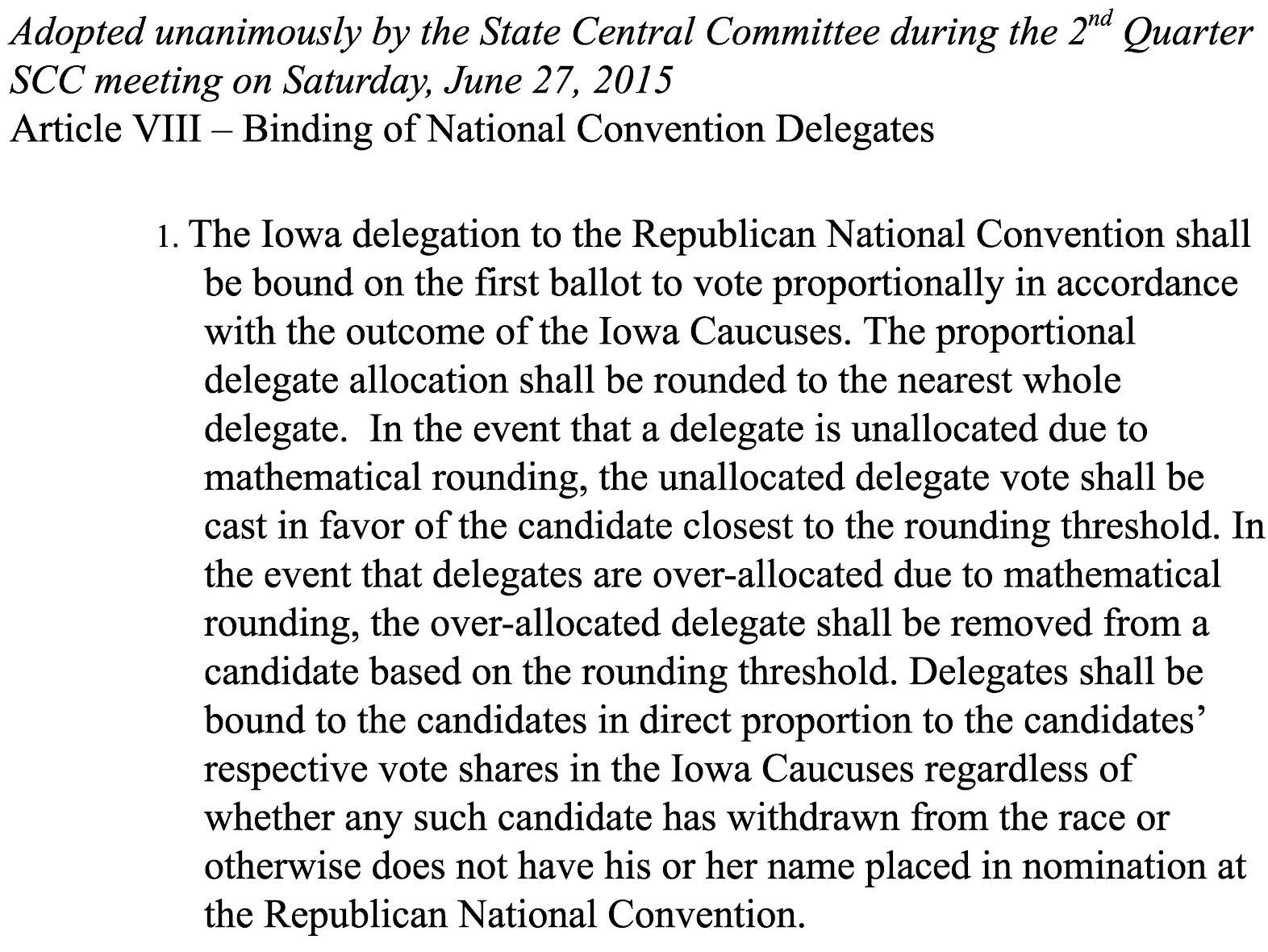
4 Importantly, if only one candidate is placed in nomination at the Republican National Convention in Cleveland, then the entire Iowa delegation is bound to vote for that candidate.
ADSENSE HERE
Nevada Republicans Set Caucuses for February 23
GOP presidential caucus date is Feb. 23.— Jon Ralston (@RalstonReports) August 29, 2015 The Nevada Republican Party has been targeting this date for much of the year, but in a Saturday, August 29 meeting, the party formalized the date of its 2016 caucuses (and other rules).
The Tuesday, February 23 date will fall just three days after the Saturday, February 20 Republican primary in South Carolina as well as the Democratic caucuses in Nevada.
NOTE: The party also voted to retain its proportional delegate allocation rules. FHQ will dig into and discuss those separately.
--
Tip of the cap to Jon Ralston for sharing this information with FHQ.
ADSENSE HERE
Never a Dull Moment in Nevada
FHQ is going to flag this typically great story from Jon Ralston on the not-so behind the scenes maneuvering ahead of leadership elections at the county level within the Nevada Republican Party. It is a nice extension to the story of the recently failed attempt in the Silver state to switch from a caucus/convention system to a primary.
Then as now, it is a story of 2016 possibilities with 2020 implications. Which is to say, this is a political battle with both short and long term incentives for state and national interests. There in the desert, Nevada has an early spot on the presidential primary calendar, but is also a battleground state in the fall. All that creates a matrix of cross-cutting incentives.
And throw in the candidates too.
In this one case, all of those interests are pulling in different directions (or parts of them are anyway). Consider that the Rand Paul campaign and those aligned with it in Nevada are attempting to advantage the Kentucky senator in the Silver state caucuses in 2016. This is not a mystery. It is inside baseball, but it is not really happening behind the scenes. And lest FHQ be accused of pointing fingers at the Paul campaign, note that this is not the first instance in political history in which self interest has played a role. It isn't even the first example in presidential nomination politics, believe it or not. The post-reform era began after all with the recommendations of the McGovern-Fraser Commission. The first nominee on the Democratic side after those reforms were instituted for the 1972 cycle was George McGovern; the same McGovern from the aforementioned commission. The Paul campaign is not doing anything that other candidates would not do.
However, they are doing it in Nevada. And the last thing that Nevada needs -- if it wants to protect that early calendar position in the future -- is more uncertainty, more chaos or more dissension in the Nevada Republican delegation. Think about this for a moment. The national parties are either indifferent to or like having Iowa and New Hampshire first because after having occupied the first two spots on the primary calendar for nearly half a century, the national parties know what they have in those states more or less.
They have a reasonable idea about how Iowa and New Hampshire will affect the process. That isn't the case in Nevada. Well, actually it is, but for all the wrong reasons. The only certainty in the Nevada (Republican) caucuses is uncertainty. After two cycles in the spotlight of the early calendar, Nevada is batting 1.000 in creating headaches for the Republican National Committee. And since the RNC-backed effort to switch to a presidential primary in the Silver state fell through and the Paul campaign is already working to help Paul out in the state, that intra-party rift and those headaches may return for round three in 2016. Again, if the only certainty is a headache, then it makes it likely that the headache symptoms will be dealt with in the future.
Of course, Democrats nationally and in Nevada do not mind seeing any of this. But it may only be Nevada Democrats that end up paying a price. One factor that bolsters the protected statuses of Iowa, New Hampshire and South Carolina is that political actors of either partisan stripe are of one mind when it comes to first in the nation/South privilege: Keep it at all costs (even if it means agreeing with the other party). Nevada Democrats should enjoy the ride now. By maintaining the caucuses for 2016, it makes it less likely Nevada will be continue to be first in the West in 2020. Another flawed Republican caucus there makes it much more likely that the RNC dumps the Silver state. Not having an early Nevada Republican caucus undercuts Nevada Democrats' case for keeping theirs (not completely, mind you, but it would make Nevada unique among the carve-out states). The national parties want certainty and if Republicans tap another western states, national Democrats will want to cede any potential organizational advantage in that state.
It is all about certainty and the Nevada experiment has provided all the wrong kind.
ADSENSE HERE
Subscribe to:
Posts (Atom)