Advertisment

Showing posts with label Iowa. Show all posts

The Iowa Delegate Count

ADSENSE HERE
FHQ has fielded some questions in various forms about the delegate count coming out of Monday's Iowa caucuses. There already appear to be a few details about the minutiae of it all that are not exactly clear. Let's add some clarity to this as best we can.

The Associated Press is reporting a delegate count in the Hawkeye state that looks something like this:
  • Cruz 8
  • Trump 7
  • Rubio 7
  • Carson 3
  • Paul 1
  • Bush 1
And then it stops. Only, the problem here is that adds up to just 27 delegates when the Iowa Republican Party was apportioned 30 total delegates by the RNC. And as FHQ has explained (via the Republican Party of Iowa), the state party is proportionally allocating all 30 of those delegates. That means that there is a discrepancy of some sort.

Many -- well, many in my Twitter feed and inbox anyway -- have speculated and/or questioned whether FHQ just has it wrong. That there are three outstanding, unallocated delegates would, on the surface, suggest that perhaps the three unallocated delegates are intentionally unallocated. As the argument goes, those three are the three party/automatic delegates. And perhaps those delegates, as is the case in a number of other states are very simply unbound by the results of the caucuses.

It is a somewhat persuasive argument, but this is a situation where appearance and reality are at odds. Here's why:

First, FHQ spoke with Charlie Szold, the Republican Party of Iowa (RPI) Communications Director, back in August about Iowa's placement on the our primary calendar. But I took the opportunity to ask him about the newly adopted delegate allocation plan as well. Recall that Iowa's was a non-binding caucus in 2012. Adding a binding element and a proportional allocation, then, constituted a pretty large change from four years ago. Mr. Szold shared with me the new rules, I glanced them over and seeing that the Iowa rules seemed to suggest that all 30 of the delegates would be allocated and bound, followed up for assurance. After double checking with the party's expert on the delegate process, Mr. Szold confirmed that all 30 would be proportionally allocated based on the caucus results, including the party delegates.

This was a process that FHQ repeated yesterday given some pushback. The answer from RPI was the same: all 30 of the delegates, including the automatic delegates, will be allocated and bound to candidates based on the results in Monday's caucuses.

Well, here we are, two days after the caucuses, and the same 27 delegates above are the only delegates that have been allocated (unofficially by the AP). Why?

As I speculated yesterday it could be because not all precincts were in in Iowa. There is such a cluster of candidates around the 1.9 percent mark that any additions or subtractions of votes to/from the total could affect whether Fiorina, Kasich, Huckabee or Christie receive a delegate. But 100 percent of precincts are now reporting. There is now an unofficial tally. Yet, there still is not a full allocation out of Iowa.

The reason for that is that the tally is unofficial. Until the results are certified by the RPI there will not be a full delegate count out of Iowa. Let us not forget that four short years ago, Mitt Romney was declared the (narrow) winner in Iowa late on caucus night. However, a little more than two weeks later, Romney's 8 vote win became a 34 vote loss to Santorum. There is, then, a cautionary approach to the vote certification and delegate count in Iowa this time around.

Again, the issue is that four candidates are vying for three remaining delegates. Fiorina, Kasich, Huckabee and Christie all are eligible to round up to a delegate, but there are only three delegates. Christie is at the bottom of the order and would appear to be the odd man out. But it is too close to call until the vote is certified. How close? The four candidates' fractional delegate shares range from .527 to .559. That is four candidates separated by just .032 delegates. In other words, the shifting of a few votes here and there is consequential to the final delegate count.

This is a wait and see sort of thing and nothing more. The count at the top of the order -- where it matters -- is not going to change.

--
One more thing to add to this:
If one calculates the allocation of 27 delegates, the distribution would look like this:
  • Cruz 7
  • Trump 7
  • Rubio 6
  • Carson 3
  • Paul 1
  • Bush 1
  • Fiorina 1
  • Kasich 1
Cruz would not have 8 delegates in an proportional allocation scheme that intends to award 27 delegates. The Texas senator would just miss out on rounding up to 8. Actually, if only 27 delegates were being allocated the outcome would be clearer. Fiorina and Kasich would round up, but Huckabee and Christie would not. The four would still be clustered but the math would be clearer starting with 27 delegates.

--
Another astute question FHQ has received concerns that Huckabee delegate. And now that Rand Paul has also withdrawn, another delegate can be added to that mix. What happens with those delegates?

They stay bound to Huckabee and Paul regardless. The only out for Iowa delegates is if only one name is placed in nomination at the convention. If only one candidate is placed in nomination, as has been the case throughout the post-reform era (save one contest, the Republicans' first under the new system in 1976), then all of the delegates are bound to that candidate.

Unlike some other states, Iowa does not permit the release of delegates nor for them to become unbound in any way.

--
There are also some questions out there concerning the delegate count on the Democratic side. Much of this seems to be the result of a lack of clarity concerning how many delegates Iowa Democrats actually have. The Iowa Democratic Party delegate selection plan suggests that there are 54 delegates, but the Democratic National Committee count (still being reviewed, so not final) has Iowa with just 52 delegates, 44 pledged and 8 unpledged (superdelegates).1 It is difficult to speculate on the tentative delegate count in Iowa anyway since the delegates will not be chosen until the later stages of the process. But that process is made even more difficult when there is some doubt about how many delegates the Iowa Democratic Party has been apportioned by the DNC.

--
More post-Iowa delegate count thoughts here.

UPDATE: Certified Republican Party of Iowa caucus results and official delegate allocation.

--
1 While the link to the IDP delegate selection plan was to a draft FHQ had stowed away, I doubled checked it against the plan on the party website at the time of the original posting. It seems to have been updated as of Thursday, February 4 and now reflects the 52 delegates the DNC has apportioned to the Iowa at this time.


Follow FHQ on Twitter, Google+ and Facebook or subscribe by Email.
ADSENSE HERE

2016 Republican Delegate Allocation: IOWA

ADSENSE HERE
This is part one of a series of posts that will examine the Republican delegate allocation rules by state. The main goal of this exercise is to assess the rules for 2016 -- especially relative to 2012 -- in order to gauge the potential impact the changes to the rules along the winner-take-all/proportionality spectrum may have on the race for the Republican nomination. For this cycle the RNC recalibrated its rules, cutting the proportionality window in half (March 1-14), but tightening its definition of proportionality as well. While those alterations will trigger subtle changes in reaction at the state level, other rules changes -- particularly the new binding requirement placed on state parties -- will be more noticeable. 

IOWA

Election type: caucus
Date: February 1
Number of delegates: 30 [15 at-large, 12 congressional district, 3 automatic]
Allocation method: proportional based on statewide results
Threshold to qualify for delegates: Somewhere between some small fraction of the vote above 0 and 1.67%.1
2012: non-binding caucus

--
Back in the summer, FHQ discussed how Iowa Republicans could respond to the new-for-2016 RNC requirement that states bind their delegates to candidates based on the results of the preference vote in primaries and caucuses. As first in the primary calendar queue, the Republican Party of Iowa has a bit of a balancing act to pull off and with a number of options to boot. On the one hand, the party could have chosen to hold winner-take-all caucuses (Carve-out states do not fall under the proportionality requirement.). And while that would have had Iowa giving a candidate a sizable delegate boost right out of the gates, going that route is not all that consistent with how the national party views Iowa's and the other carve-out states' role in the process; as part of the "on-ramp".2 Iowa also has some interest in retaining its first-in-the-nation status. Acting counter to the intent of the national party is not in the the way to achieve that outcome.

Instead, Iowa Republicans opted to comply with the new binding requirement by adopting a strictly proportional method of allocating its 30 delegates to the national convention in Cleveland.3 And they did so in the simplest terms, tying the delegate allocation to the statewide vote in the February 1 caucuses (rather than splitting it up based on the statewide and congressional district results). Candidates, then, will win delegates approximately in proportion to their vote in the caucuses assuming they receive at least a 3.33% share of the vote to mathematically qualify for delegates.

The caucus/convention process will then proceed as it always has. The difference in 2016 will be that delegate slots will be bound to candidates based on the collective precinct caucus results. Those slots will be filled in subsequent steps of the process. That is the big change for Iowa and the majority of other non-binding caucus states from 2012.4

--
State allocation rules are archived here.


--
1 If n-1 candidates all receive a share of the vote that rounds their share of delegates awarded up, and if there is still an unallocated delegate, then that last candidate would be granted that delegate by virtue of being "closest to the rounding threshold". This is technically true even if that candidate -- the last remaining candidate -- receives just one vote. Now, this is unlikely to happen, but does give us some indication that, depending on how the vote breaks, Iowa could allocate delegates to some candidate with virtually no threshold.

2 Roughly, that "on-ramp" is a sequential retail politics environment that gives voters in smaller states the opportunity to meet and hear from the candidates face-to-face. By extension that levels the playing field by not forcing candidates, their campaigns and attendant super PACs to immediately prepare for a multi-state fight waged over the airwaves. In other words, the on-ramp is intended to nurture competition and potentially create momentum behind any candidate, regardless of resources.

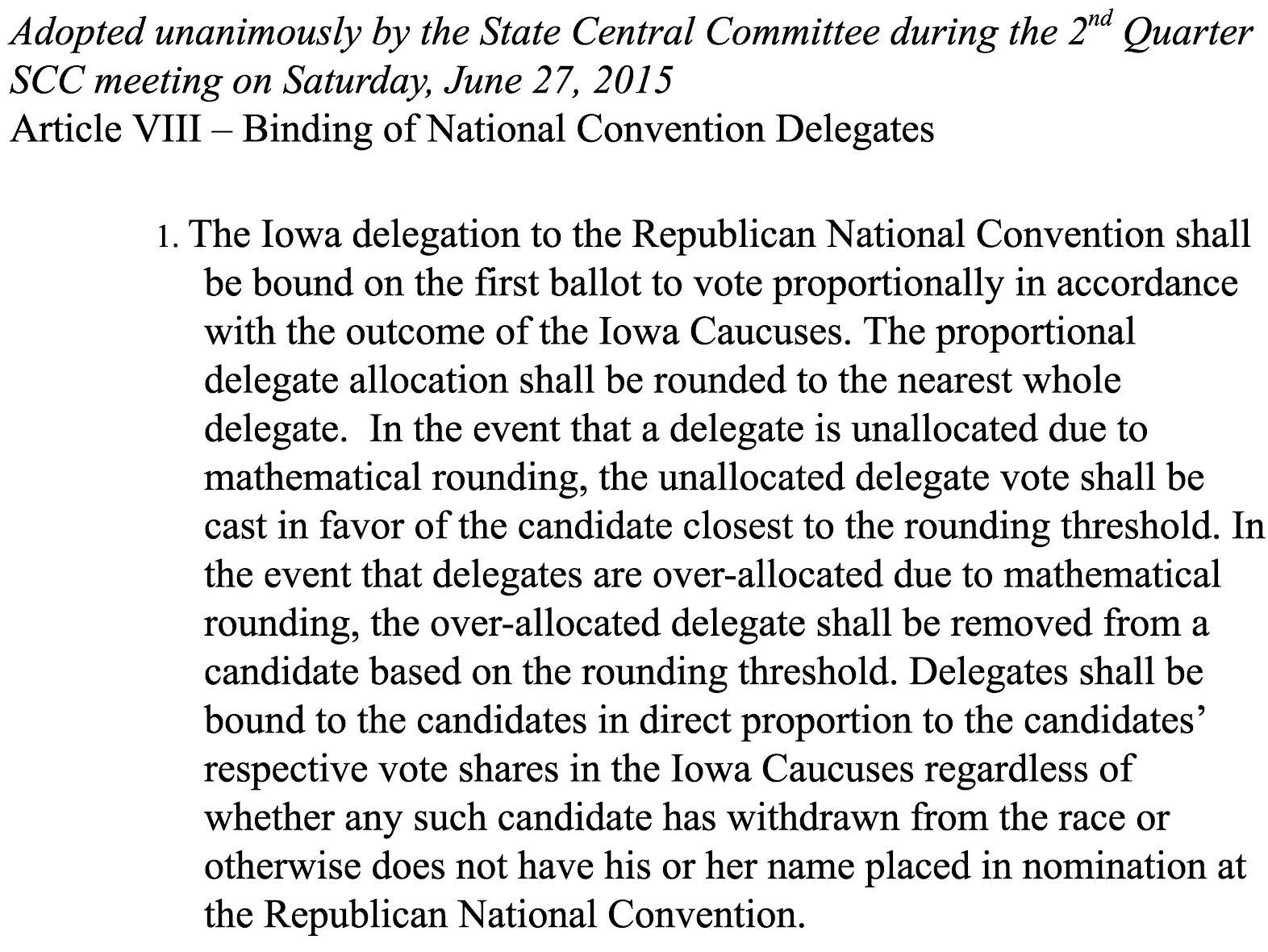
3 Here is the relevant section from Article VIII of the Bylaws of the Republican Party of Iowa:

4 Importantly, if only one candidate is placed in nomination at the Republican National Convention in Cleveland, then the entire Iowa delegation is bound to vote for that candidate.


Follow FHQ on Twitter, Google+ and Facebook or subscribe by Email.
ADSENSE HERE

Iowa Republicans Trying to Find the Right Balance in 2016 Delegate Allocation

ADSENSE HERE
PLEASE SEE A MORE DETAILED DISCUSSION OF THE DELEGATE SELECTION PLAN ADOPTED BY THE REPUBLICAN PARTY OF IOWA HERE.

It is a real shame that Jennifer Jacobs' Des Moines Register story on the Iowa Republican Party's deliberations on delegate allocation in 2016 was released after 5pm on the East coast and on a day with so much other news. This really is an interesting, if not important, story.1

The question Iowa Republicans are wrestling with now is something that FHQ discussed at the beginning of May. Basically: How does a state party make the transition from non-binding caucuses in one cycle to being a binding caucus state in the next? What kind of delegate allocation rules do you, as a party, craft? And how?

As Iowa Republican Party officials let on to Jacobs, the process is tricky. In reality, it is that much trickier because Iowa has the first contest. It is all well and good to just select a method of delegate allocation at random, but all things held equal, Iowa Republicans theoretically have a different calculus on this than most if not all other states. Very simply, it is more difficult for Iowa to devise rules on delegate allocation when other states 1) have tried and tested a particular method over time and 2) will likely see a significantly winnowed field of candidates in a March 1 or April 26 primary.

South Carolina Republicans, for instance, have a pretty good idea of how a winner-take-most (winner-take-all by congressional district) plan works. There is a reason the party has used that method for as long as it has. California Republicans utilize a similar allocation plan to South Carolina's, but with a June primary, the list of surviving viable candidates will look decidedly different from the group that will brave the mid-winter cold of Iowa four months prior.

If you are the Iowa Republicans, how do you plan for the possibility that the winner of your early/first contest may not actually still be around later in the process, much less at the convention? How do you bind those delegates in a way that accounts not only for that but also reflects the results of the caucuses?

For starters, Iowa Republican Party Chairman Jeff Kaufmann says that the party is leaning toward a proportional rather than winner-take-all method. As FHQ argued before, such a move is at least partially one made to preserve the state's first-in-the-nation status. No, Iowa is not affected by the proportionality requirement -- none of the carve-out state are -- but the RNC is unlikely to look on a move to adopt winner-take-all rules favorably.

So, no winner-take-all.

However, as FHQ mentioned repeatedly in 2011-12 and already here in 2015, there are a number of variations to the proportional method of delegate allocation as defined by the Republican National Committee rules on delegate selection. In the thought experiment FHQ constructed in initially bringing up the Iowa delegate binding question, due to the likely large field and depending on how the rules are written, Iowa could be proportional, but with a threshold that could make it winner-take-all or nearly winner-take-all. If, for instance, Iowa Republicans set a minimum threshold for receiving any delegates at 20%, then it is not inconceivable that with such a large field, only one candidate would break that barrier. And he or she would potentially be awarded all of the delegates (either statewide and/or at the congressional district level). Iowa would become a backdoor winner-take-all state.

What that demonstrates in reality is that state parties have a great deal of latitude under the national Republican guidelines in setting these delegate allocation rules. And the proposals in Iowa appear to be closer to a truly proportional distribution of delegates. As Jennifer Jacobs describes it:
Candidates would be awarded a percentage of delegates that roughly matches the percentage each candidate wins in the Iowa caucuses. For example, say former Pennsylvania U.S. Sen. Rick Santorum wins 20 percent on Feb. 1. He'd be assigned 20 percent of Iowa's 30 delegates. That's six delegates.  
The proportional numbers would be rounded to the nearest whole delegate, so a candidate would have to earn at least 3 percent of the vote in the caucuses to get just one delegate.
This is a proportional plan with no threshold other than a candidate getting a share of the caucus vote large enough to round up to one delegate.2 It is a more open plan rather than a closed one, limiting the number of candidates who may qualify for delegates.

FHQ should also note that this plan Jacobs describes is a truly proportional plan, allocating delegates proportionally based on the statewide results alone. The plan described does not split the allocation across statewide and congressional district results. In other words it makes no distinction between at-large and congressional district delegates in the allocation. To be very -- VERY -- clear, the plan Jacobs describes separates the allocation and election/selection parts of the delegate process. All delegate slots (regardless of whether they are at-large or congressional district slots) are allocated to candidates based on the statewide results in the likely February 1 caucuses. Delegates to fill those allocated slots are elected/selected at either congressional district conventions (12 congressional district delegates) or at the state convention (at-large delegates). Those delegates are then bound to vote for the candidate to whom their slot was allocated.

--
That binding mechanism beyond the caucuses (and the Iowa state convention) is the other part of the calculus that Iowa Republicans are dealing with now. How long does that -- the bind -- last at the national convention and under what conditions? Actually the considerations in Iowa add another wrinkle. Again, from Jennifer Jacobs:
If the nation rallies around one favorite candidate in the states that follow Iowa, the convention will be easier, Kaufmann said. Iowa GOP officials could pass a rule that says if only one candidate's name is placed in nomination, all of Iowa's delegates are bound to cast their first vote for that one candidate.  
But what if more than one Republican is up for nomination at the convention? One idea is to reshuffle the delegates so that "all of Iowa's votes will go to candidates who have officially been placed in nomination," said David Chung, a member of the party's governing board. That way, votes aren't being cast for candidates no longer in the race. If there are, say, three candidates in the nomination fight, 100 percent of Iowa's delegates would be divided among those three, in proportion to the number of votes each got in the caucuses.
Now, both scenarios represent planning that is innovative but is also unique to either Iowa, the 2016 cycle or both. We might call these contingencies a "rebinding" of the delegates. That, however, is a loaded term. In a fractious party -- state or national -- rebinding gets right to the heart of the fairness of the process. Yet, what the proposals indicate is a conscience effort on the part of the Republican Party of Iowa to create a formula that can adapt to the changes that will almost certainly occur as the Republican presidential nomination process moves from its official kickoff in Iowa to the national convention in Cleveland. The party is seemingly trying to create a formula that always makes an attempt to accurately reflect the results of the caucuses.

--
Overall, these are difficult issues to tackle. And the uncertainty of the cycle to this point is driving a lot of contingency planning. Since Iowa is the first delegate selection event, the rules behind its delegate selection process almost have to be complicated enough to accommodate a broad candidate landscape, a landscape that will evolve over the course of primary season (based on the results of other contests, the influx of super PAC money and other factors).

The new RNC delegate binding rules have brought or will bring about rules changes at the state level. In total, that may end up being a lot of rules changes. The more rules changes there are, there greater the potential for unintended consequences. That may be consequential.

...or it may just end up being overplanning on the other side of the 2016 election. It is interesting to consider the implications though.

--
1 Results may vary on just how interesting or important it is to you, valued reader, but for FHQ, well...

2 Depending on how the rules are written, a candidate being awarded one delegate could have to get 3% of the vote or a share that would round up to 3%, say, 2.5%. As is often the case, though, often times delegates will be awarded sequentially starting with the top votegetter and working down the vote-based rank ordering. The rounding more often occurs on the actual delegate awarding rather than the vote share. Let's use the Santorum example from Jacobs' description, but assume that he won 19.9% of the vote.
30 (total Iowa Republican delegates) X .199 = 5.97 delegates
Santorum's total haul would not be 5.97 delegates. That would round up to 6 delegates. There are no fractional delegates. However, states deal with rounding differently to account for the fact that there are no fractional delegates allowed. Some always round up while others round up only if the fraction is higher than .49. The rounding rules impact the candidates at the top end of the rank ordering, but that is minor in view of the fact that those further down the list could get shut out of the allocation due to how the rounding rules are constructed. The 2012 Iowa Republican caucus results offer a nice example of this issue.

2012 Iowa Republican Caucus Results and Delegate Allocation
CandidateVote (%)Delegates
(Raw/Unrounded)
Delegates
(Rounded Down)1
Delegates
(Rounded Up)
Santorum24.67.3878
Romney24.57.3578
Paul21.46.4267
Gingrich13.33.9944
Perry10.33.09332
Bachmann5.01.502--
Remainders3----1--
Notes:
1 Delegates are rounded up only if the fractional delegate is greater than .49. Fractional delegates at or below .49 are rounded down.
2 The Perry number is not rounded up as the rest are because there were only three delegates that remained to be allocated by the time the sequence worked down the list to him.
3 Remainders in this case means any delegates left unallocated due to the rounding rules, not the candidates who received a smaller share of the Iowa caucus vote than Rep. Bachmann. 

To reiterate, the top votegetters are only marginally affected. In this instance there are minimal differences in the delegate gaps between candidates based on the rounding rules. However, those candidates with smaller vote shares may or may not qualify for any delegates depending on the rounding. With a sequential, top-down allocation with round up rules, Bachmann gets shut out of delegates where she gets two delegates under different rounding rules.


Follow FHQ on Twitter, Google+ and Facebook or subscribe by Email.
ADSENSE HERE